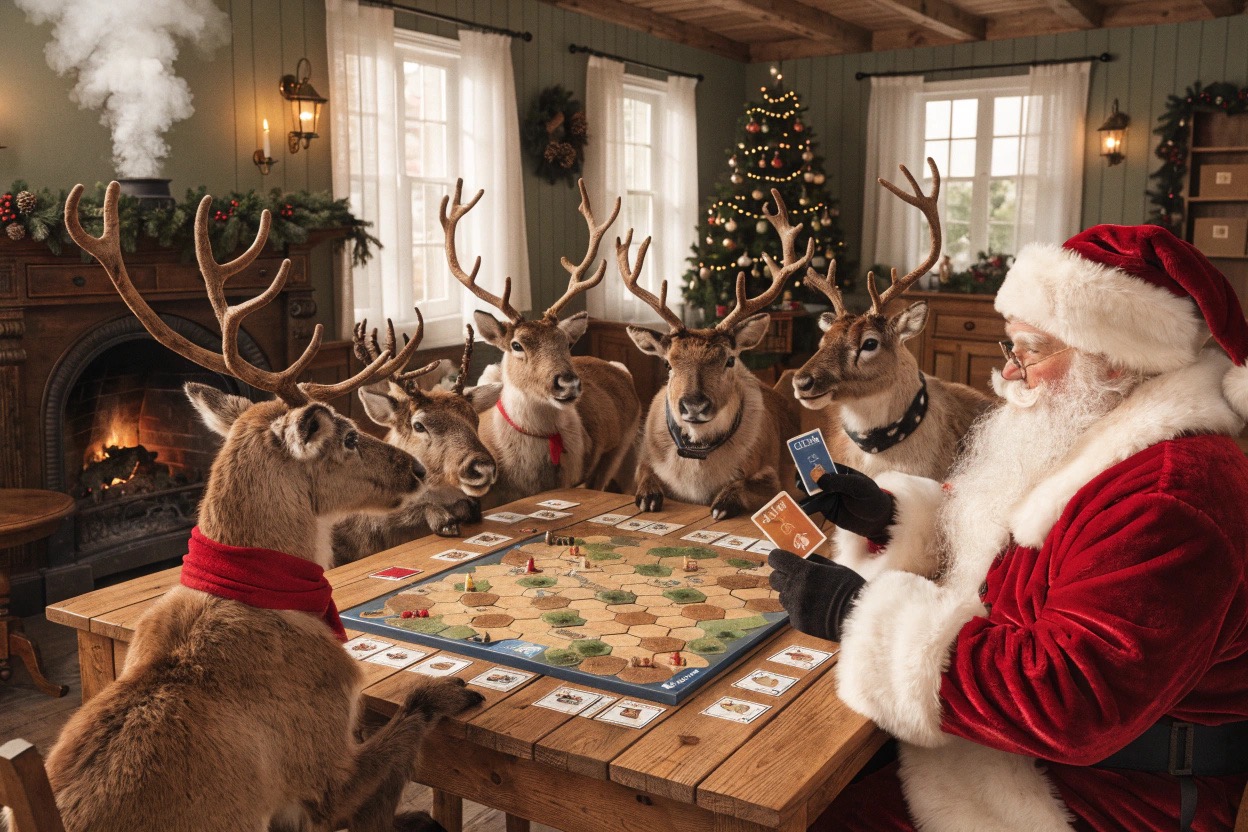
Talisman looks harmless enough: A colourful fantasy board with wizards, warriors, and countless encounters on their quest for the Crown of Command. Beneath the whimsy lies one of the most unpredictable, polarising and enduring fantasy board games ever made. Reminiscent of Monopoly's brutal outcomes, there can be only one that ultimately remains. Yet for over forty years; Talisman has enchanted, infuriated and inspired players, spinning them around the exact same board and towards the ever consistent sequence of inner regions to reach the always predictable ending.
Origin story
Before Warhammer became a global miniature empire, Games Workshop was a scrappy British company selling Dungeons & Dragons rulebooks and publishing White Dwarf magazine. It was in 1983 when designer Robert Harris walked into the Workshop with a fantasy prototype called Necromancer: a simple spiral game about ascending to a magical island. With its mix of D&D flavour and family-friendly play, it was quickly modified to become Talisman: The Magical Quest Game, replacing necromancy with a mystical Crown of Command.
Talisman became Games Workshop's first mass-market success, long before orcs, bolt-guns and Grimdark universes. It proved that fantasy board games could sell, not just to hobbyists but to ordinary families wandering through toy aisles. Just as Twilight Imperium later transformed Fantasy Flight Games from a small studio in Minnesota into a world-class publisher of epic space sagas, Talisman transformed Games Workshop from a distributor into a full-fledged creative powerhouse. Without Talisman's success, there may not have been Warhammer, or the publicly listed mammoth corporation that controls it.
Five editions, five eras
Since its debut, Talisman has undergone five major editions, each reshaping its rules, artwork and tone with the time:
- 1st Edition (1983) — Games Workshop. Black-and-white cards, paper tokens.
- 2nd Edition (1985) — Games Workshop. Full colour, polished components.
- 3rd Edition (1994) — Games Workshop. Plastic components and new variants.
- 4th Edition (2008) — Fantasy Flight Games. 1st 3D models / most expansions.
- 5th Edition (2024) — Avalon Hill. Less brutal, more co-operative.
Across these incarnations, Talisman has sold over 800,000 copies and still draws new fans every year. Four decades on, it continues to mesmerise and frustrate in equal measure: a relic from a more whimsical era of board gaming. One that valued imagination over efficiency, and chaos over control.
Why it survives
One reason Talisman survives generation after generation is its mod-friendly nature. The base game is a playground for tinkerers, artists and creators. Like Monopoly it has been re-licensed for both Batman and Harry Potter variations; yet its biggest flaw might also be one of its defining features.
"Talisman doesn't survive because it's balanced. It survives because it's moddable."
This is the same principle that keeps ancient games alive for millennia: depth through simplicity, longevity through adaptability. The games that communities invest in are the games that welcome modification.
The static spiral problem
The infamous board has remained the same for nearly half a century. Three regions that spiral inwards towards the path of peril. Players are like cattle as they move around the board. The spiral draws you inward, step by step, with no escape. It is thematically brilliant: a literal quest towards destiny, but mechanically cruel and somewhat predictable. For such a rich game filled with countless characters and events, the monotony of the same things being in the same place every time seems like a missed opportunity.
This is precisely what Talisman Worlds addresses. Built on our Hexmaps engine, it replaces the static board with 61 hexagonal tiles across four concentric rings plus a hidden ending. Every game generates a different board layout, with Dungeon expansion support included.
Talisman Worlds is available in the mods library. Download it, shuffle the tiles, and discover a Talisman you have never played before.