A good board game should not only engage the table in what everyone is doing, but more importantly, who is doing what with whom, when and why. A great game not only entertains the imagination, but also inspires creation. Few games embody this as well as Twilight Imperium. Within some circles it is an urban myth. To others it is inconceivable that such a game could even exist.
Taking between ten to twenty hours to play, even for the most seasoned of players, with game lengths easily doubling if containing newbies. The game is so fabled for its length that it eventually becomes a physical endurance test as you pass into the tenth hour of play. In its thirty years of mythic existence and extreme length, only 6 players have ever been able to sit at the table at one time.
It started in 1997 with a single designer, Christian T. Petersen, assembling cardboard tokens and hand-cut tiles out of his apartment in Minnesota. Petersen had founded Fantasy Flight Publishing two years earlier as a European comics importer. Twilight Imperium was the company's first game, debuting at Origins Game Fair where it sold out within two days. Just as Talisman transformed Games Workshop from a D&D distributor into the publicly listed miniatures empire it is today, Twilight Imperium transformed Fantasy Flight from a one-man operation into one of the most respected publishers in modern tabletop gaming.
The second edition arrived in 2000, replacing those cardboard spaceships with plastic miniatures and introducing proper artwork. The third edition in 2004 rebuilt the game from scratch with modular hex tiles, action cards and a political system that rewarded negotiation over brute force. Then in 2017, the fourth edition refined everything: streamlined combat, faster scoring, and a tighter economy that kept all players engaged until the final round. Each edition made the galaxy bigger, the factions deeper, and the social contract more central to the experience.
Prophecy of Kings
When the fourth edition launched in 2017, it already felt like the final word. Fantasy Flight had folded the best ideas from Shattered Empire and Shards of the Throne directly into the base game: trade agreements, political intrigue, flagship units, objectives that ended stalemates. Seventeen factions, all rebalanced for modern play. For most of us, the notion of expanding what was already the largest strategy game on the market felt absurd. There was nothing left to add.
Then in 2020, Fantasy Flight released Prophecy of Kings and proved us wrong. Seven new factions pushed the roster to twenty-four. Mechs gave ground combat an entirely new dimension. An exploration system replaced the dead turns of moving through empty space with discovery cards for cultural, industrial and hazardous worlds. Leaders introduced personal progression: agents who acted on your behalf between rounds, commanders who unlocked as your empire grew, and heroes whose one-time abilities could swing the final act. Relics and legendary planets scattered across the galaxy gave players reasons to venture beyond safe borders.
Thunder's Edge arrives
When Fantasy Flight unveiled Thunder's Edge in mid-2025, communities across the globe were lit up with the news. The second major expansion introduces new neutral units, the eponymous legendary planet, breakthrough mechanics that help evolve factions quicker through discovery, and a second disconnected fracture of the universe for exploration.
More importantly, it brings together all of the codices that have been released since the 4th edition first hit print. Codices represent official Twilight Imperium variations and rule changes, and for the first time fans can buy components from the source rather than printing them at home. It also includes Twilight's Fall, the first official variant: a new game mode with unique components that lets players descend into the darker legacy of Mahact power.
Among the codex factions now printed in full is the Council Keleres, an intergalactic peacekeeping agency funded by the Galactic Council. The Keleres were not born from the board game at all. They were invented by Fantasy Flight's RPG team for Embers of the Imperium, the tabletop roleplaying game set in the TI universe. In a traditional RPG, you need a diverse group of players to cooperate and go on missions together. In Twilight Imperium's lore, all races are locked in a brutal galactic war. The Keleres solved that problem: a cross-faction agency that justified mixed-species crews. Fantasy Flight then built a corresponding board game faction and released it digitally for free in Codex III. A mechanic designed to fix one game found its way back into the mothership, where it started to inspire others.
The modding community
Long before Thunder's Edge, modders had already carried the torch. Communities around the world have been designing new factions, political systems, relics and custom map setups. Not to replace the original, but to express their own part within the ever growing mythos surrounding this game.
No collection of modifications can surpass the legendary Discordant Stars: a freely available community-driven expansion containing 34 new factions fully compatible with Prophecy of Kings, plus 24 new system tiles, 16 exploration cards, 7 relics and 30 action cards. Most impressive is that it also supports other mods. It is not alone:
- Twilight Wars — streamlined 2-player variant, under 3 hours
- Monuments — buildable wonders that grant persistent galactic effects
- Homebrew faction builders — tools for designing and balancing custom species
Why it works
The secret to Twilight Imperium's modularity lies within its sandboxed nature and the number of rule-breaking elements that can be combined, debated and threatened with. It is the empowerment of the people behind the factions. Not balanced in the sterile, mathematical sense; balanced through negotiation, politics and the unpredictable beauty of player interaction. One clever bargain can undo an empire. One betrayal can change the fate of the table. That social elasticity is what lets mods thrive. You can add factions, redesign laws or rework objectives, and the game still holds. It bends, but never breaks.
Hyper Imperium
Despite its fabled length, the Moddable team play as frequently as possible. Over the years, we have started to collect our own modifications, collectively known as Hyper Imperium. Five modular rule changes that tighten the experience:
- Hyper Movement — faster fleet positioning in early rounds
- Hyper Trades — reworked economy that punishes hoarding
- Hyper Objectives — shared secrets that create alliances and betrayals
- Hyper Factions — 100-point mercenary builder for custom species
- Hyper Agendas — blind voting with influence cards
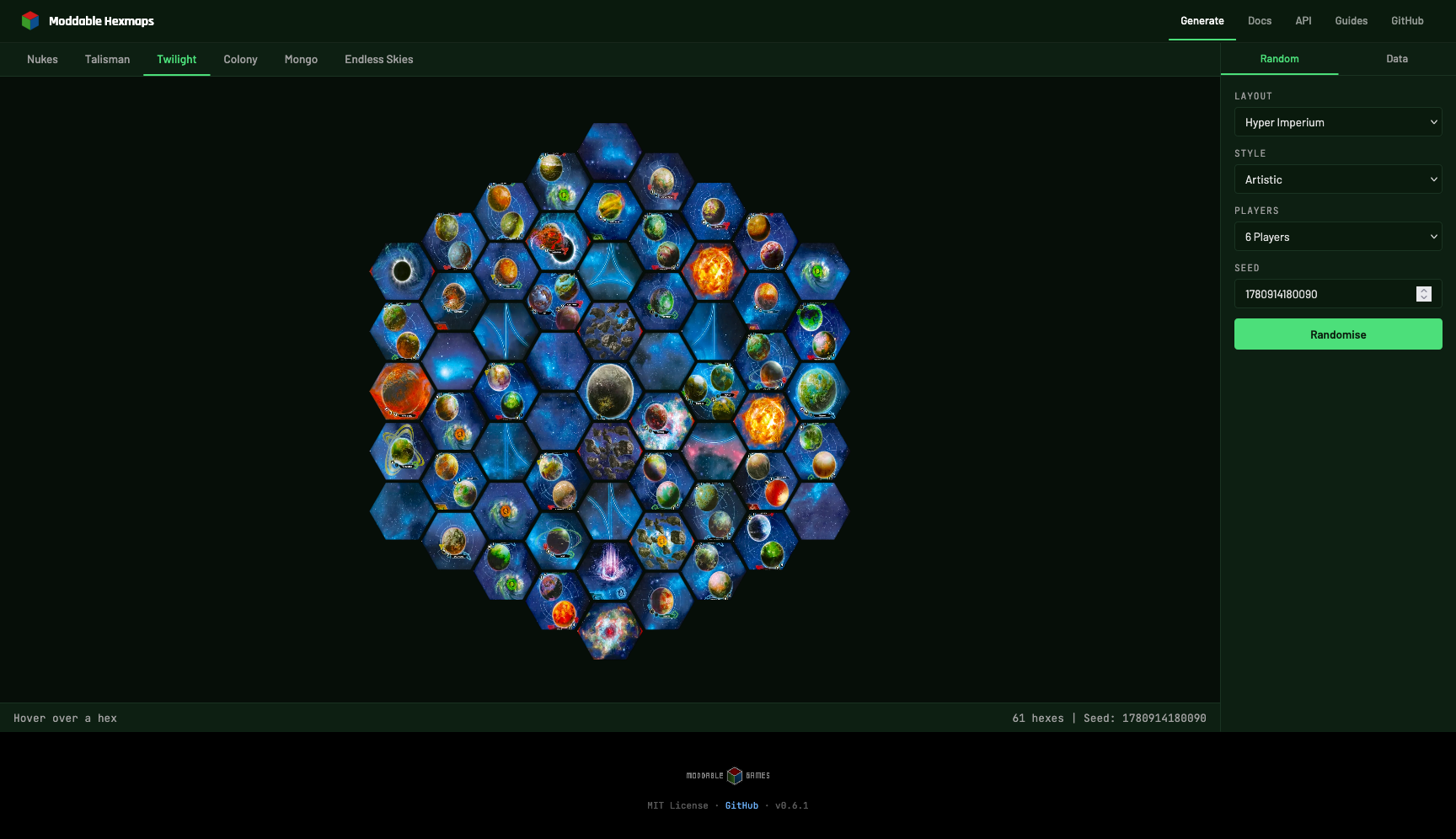
Hyper Imperium is in active development. Follow our progress on Discord or download the current ruleset from the mods library.