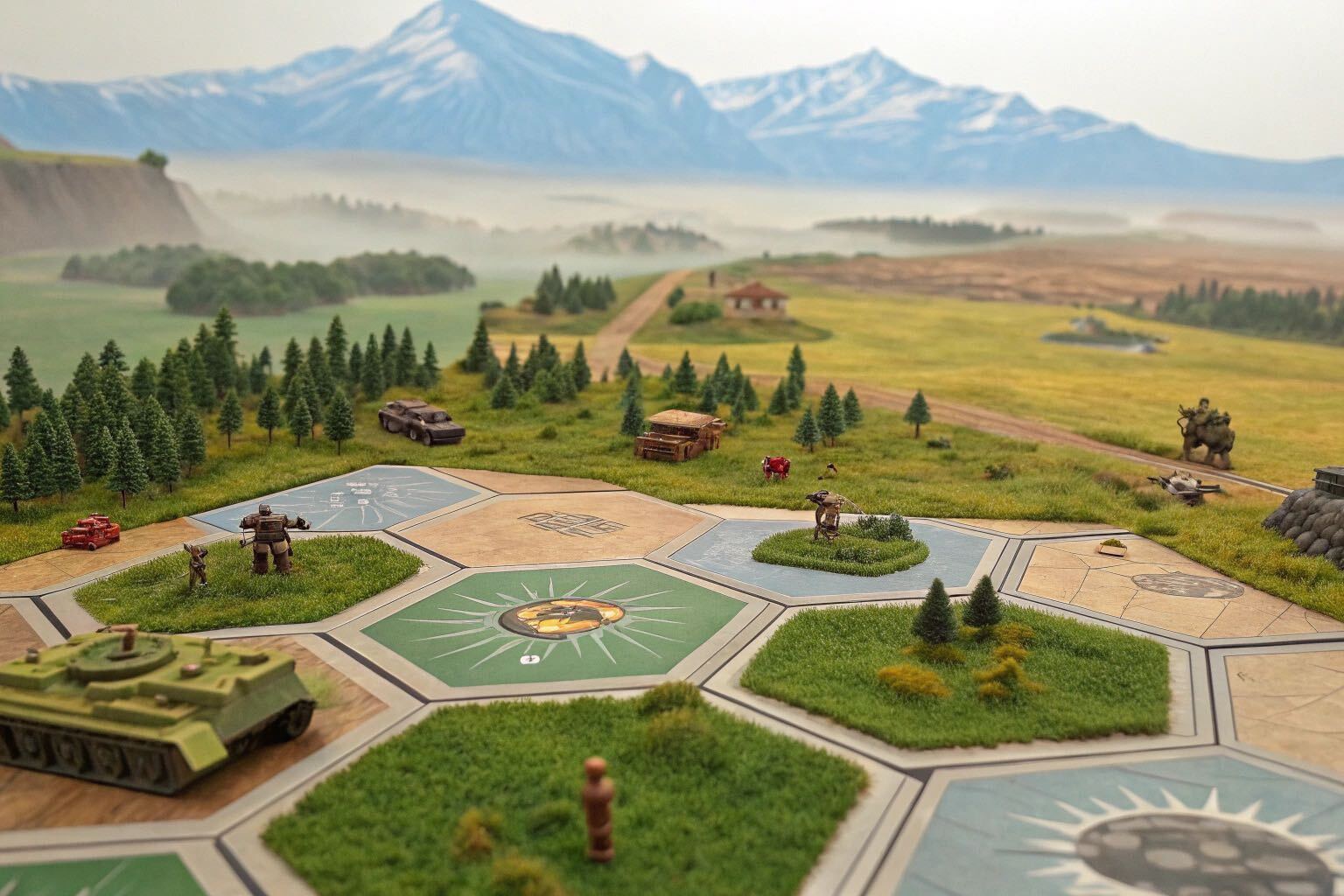
Catan is popular. By some accounts, the most popular game of the modern era. A gateway game that has sold over 45 million copies and introduced countless families to a life of board games beyond Monopoly. Online versions are making millions despite it also being freely available in various forms. Catan is one of the most pirated board games on the planet, with several of the largest online marketplaces selling more unoriginal copies than officially authorised ones.
Moddable.Games does not have this problem. In fact, we encourage it.
A game you already own
We are designing open-source games, freely available for others to modify and redistribute under their own brands. Our first game is Nukes, which in many ways was born from understanding the origins and evolution of chess. Although Nukes has been under development for over a decade, it was not until around a year ago that we realised you could play the game using a set of Catan tiles as the board.
Nukes uses hex tiles as its board. Catan uses hex tiles as its board. Nukes uses generic tokens (no unique pieces). Catan ships with generic wooden settlements and roads, but you could also use pieces from Checkers, Go or Draughts.
Your first standalone game can be played tonight with a box you already own.
What Nukes actually is
Nukes is a cold-war territory control game on a modular hex map. No dice. No cards. No luck. Every outcome is the direct result of a decision you made.
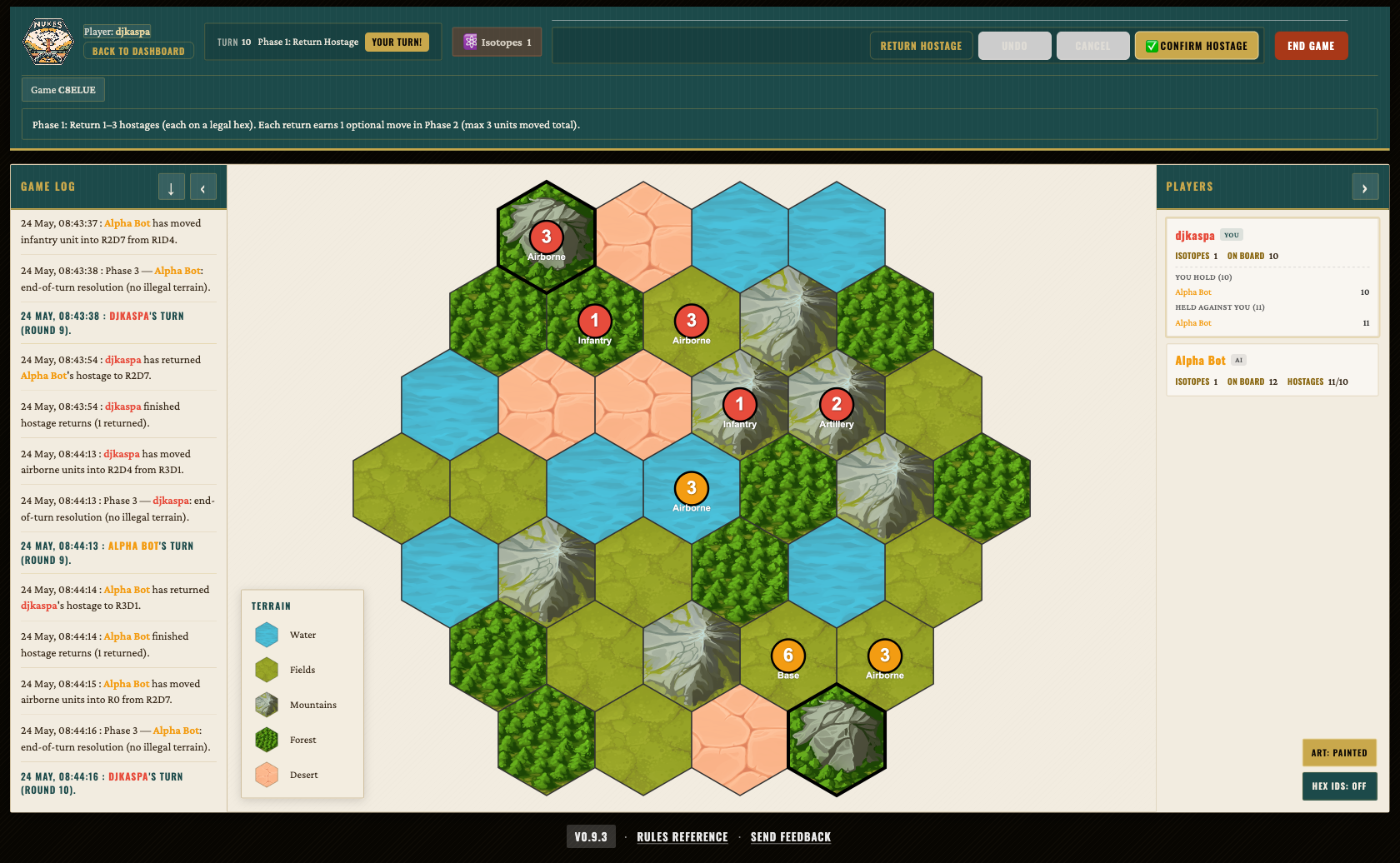
The core mechanic: units are fluid. A single token is Infantry. Two tokens stacked together become Artillery. Three become Airborne. Four or more become a Base. The same physical pieces change behaviour based purely on how you group them:
- Infantry floods through same-biome regions like water filling a container
- Artillery jumps in straight lines over occupied hexes
- Airborne slingshots exactly two regions, skipping what is between
- Bases do not move, but convert isotopes and boost passing platoons
Win by destroying an opponent's city via nuclear strike, establishing a Base on their city, or being the last player with units on the board.
The hostage engine
The second core mechanic: hostages are your engine. When you capture enemy units in combat, you can hold them. Each turn, you must return 1-3 hostages to earn your moves. Every aggressive action fuels your next turns, but simultaneously reinforces your opponent's army.
"What if every aggressive move also strengthened your opponent?"
Capture aggressively and you fuel your next few turns, but those returned hostages land back on the board as enemy reinforcements. Starve your opponent of hostages and they cannot move, but neither can you, because you have nothing to return. The equilibrium shifts constantly.
It is simple enough to explain in a few sentences, but generates decisions that both chess and poker players would recognise as meaningful. This is the design philosophy of emergent complexity from minimal rules that we explored in Conquering the Constraints of Chess.
The Catan conversion
To play Nukes with your Catan set:
- Use 19 hex tiles as your board (any configuration)
- Assign biomes to terrain: Fields, Forest, Mountains, Desert, Clay Pits
- Use settlements or roads as tokens (one colour per player)
- Download the rulebook from the game page
No new components. No expansions. No purchases. The game you already own now contains a second game inside it.
How it compares
Where Nukes sits in the lineage of deterministic strategy:
- Checkers — 2 piece types, fixed board, more games than atoms in the universe
- Go — one piece type, one rule, more possible games than any other system
- Chess — 6 unique movers on the same grid, lands somewhere between the two
- Catan — dice, 8 terrains, up to 6 players, billions of outcomes
- Nukes — 2 components, modular board, no theoretical ceiling
Play it online
You do not need a Catan set. Nukes is live at nukes.moddable.games with the full board, online multiplayer, and async play. Built on our open-source Hexmaps engine.
For the 45 million of you who already own a copy of Catan: you also own Nukes now, so please help us let the other forty-four million, nine hundred and ninety-nine thousand, nine hundred and ninety-nine people know.